MLB Day vs. Night Game Betting: How Start Times Affect Outcomes
 Available in US
The Thursday Afternoon Edge Nobody Talks About
For two years, I ignored day games entirely. They started while I was working, the lineups looked odd, and the motivation level felt lower than a primetime evening fixture. Then a friend showed me his results from betting exclusively on weekday day games, and the numbers were striking — his ROI was nearly double his evening game returns. I started digging into why, and what I found reshaped my entire weekly schedule of baseball betting.
Day games in MLB — typically starting between 12:30pm and 4pm local time — represent roughly 25% of the regular-season schedule. They cluster on Wednesdays (getaway days before travel), Thursdays and Sundays. These games carry structural characteristics that differ meaningfully from evening contests, and those differences create exploitable patterns in the betting market.
See also: build a postseason plan with our MLB playoff betting strategy.
Lineup and Rotation Decisions in Daytime Baseball
Managers rest their best players more frequently in day games, particularly on getaway days when the team has a flight immediately after the final out. A team’s everyday shortstop might sit in favour of a utility player. The cleanup hitter nursing a sore knee gets a day off. These lineup changes directly affect the team’s offensive output and, by extension, the moneyline and totals markets.
The market adjusts for announced lineup changes, but the adjustment is often incomplete. A team missing two regular starters from its lineup sees its moneyline shift by perhaps 5-8 cents. The actual impact on expected run production is closer to 10-15 cents when the absent players are high-OPS contributors. That gap between the market’s adjustment and the true impact is where day game value lives, and it repeats every Wednesday across the league.
Pitching patterns differ too. Day games after night games — the dreaded “day-after-night” scenario — are associated with lower offensive performance from the batting team that played the previous evening. Players who finished a night game at 11pm and then report for a 1pm start the following day show measurable declines in exit velocity and plate discipline. This effect is small but consistent, and it favours the team that did not play the previous night or that had an off day.
How Sunlight Changes the Way Baseball Is Played
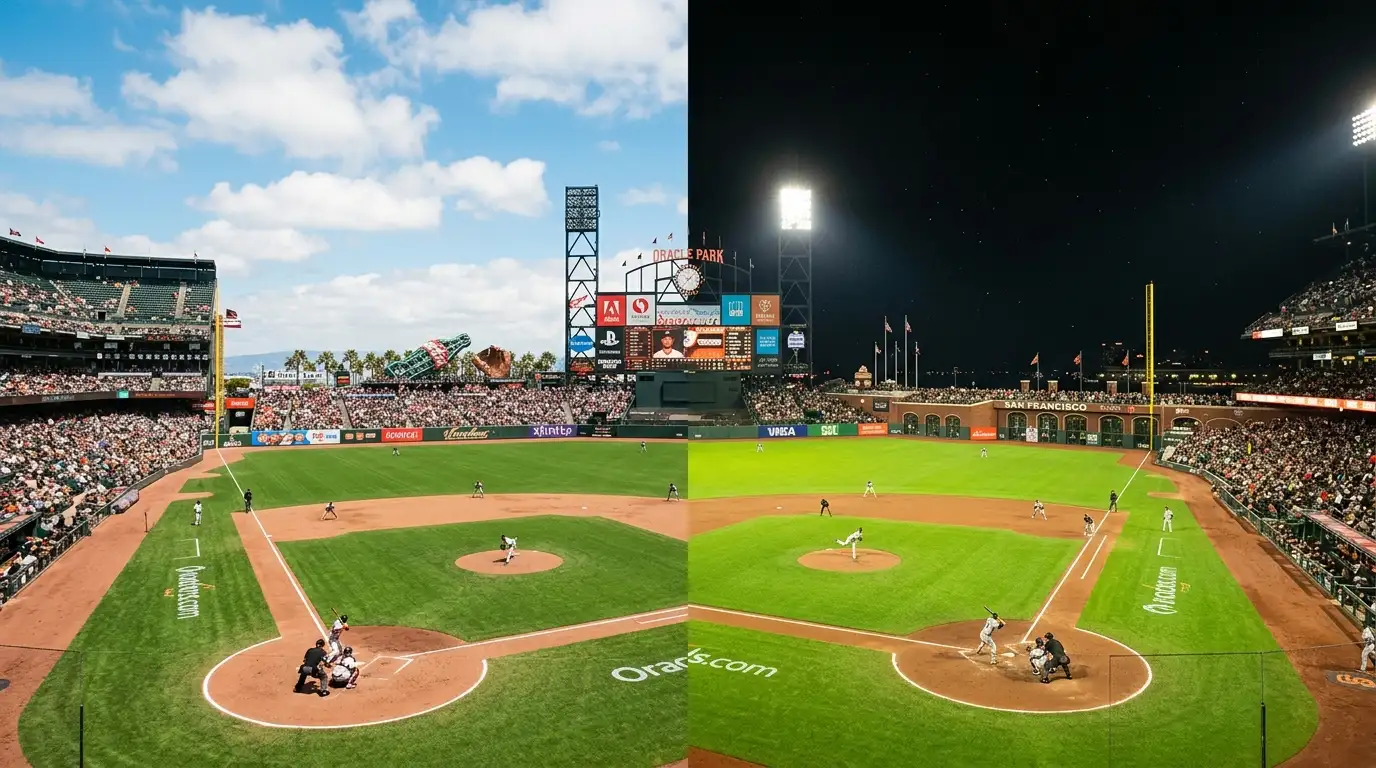
Afternoon sunlight creates visibility challenges that night games eliminate entirely. Fly balls hit into a bright sky are harder to track, leading to more errors and more balls dropping for hits. High pop-ups — routine outs under the lights — become adventures in daytime, particularly at parks where the sun angle aligns with the trajectory of fly balls to certain field positions during specific months of the season.
Pitching is affected differently. The absence of artificial lighting changes the visual background against which hitters track the ball. Some parks have batter’s eye walls designed for night games that perform poorly when the sun shifts their contrast ratio in the afternoon. Hitters at these venues report difficulty picking up the ball out of the pitcher’s hand during certain hours, which suppresses offence and produces lower-scoring games than the ballpark’s night-game averages would suggest.
The totals market does not consistently account for these time-of-day effects. A park might have a night-game scoring average of 9.2 runs and a day-game average of 8.4 runs, yet the total for a day game is set at 9.0 based on the park’s overall factor. That 0.8-run discrepancy translates directly into under value. MLB drew 70.75 million fans in 2023 attendance, and the shift in viewing habits means sportsbooks price based on aggregate data that blends day and night patterns rather than separating them.
Time Zone Travel and the West Coast Swing
An East Coast team flying to the West Coast loses three hours. A 1pm day game in Los Angeles starts at 4pm body-clock time for a visiting team from New York. That is manageable. But a 12:30pm day game in Seattle starts at 3:30pm body-clock time for a team that played a 10pm finish in Tampa the night before — factor in travel time and hotel arrival, and those players might have had five hours of sleep.
The reverse is worse. A West Coast team travelling east for a 1pm day game is starting at 10am body time. Baseball performance data shows measurable declines in reaction time and bat speed for players operating three hours ahead of their circadian rhythm. These teams underperform their season averages in early-start Eastern road games, and the effect is strongest in the first two games of a series before adjustment kicks in.
I flag every series where a team crosses two or more time zones and has a day game within the first 48 hours. Those games produce the most consistent situational edges in MLB betting — not because the teams are bad, but because the human body has not caught up with the schedule. The market prices team quality but rarely prices jet lag.
See also: betting for baseball for situational and schedule-based tips.
Scheduling Your Betting Week Around the MLB Calendar
For UK bettors, the time zone situation creates a practical advantage. MLB day games starting at 5pm to 9pm UK time are easier to watch live than night games starting at midnight or later. You can monitor lineups, check weather, and place bets during reasonable hours rather than setting alarms for 2am first pitches. This is not a trivial consideration — alert, well-rested bettors make better decisions than tired ones operating past midnight.
My weekly schedule prioritises three day-game windows. Wednesday getaway games, where lineup rest creates the widest mispricing. Thursday standalone day games, which often feature pitching matchups the market has not focused on because the slate is small. Sunday day games, which carry the highest volume and the most varied lineup decisions as managers balance rest, platoons and upcoming series considerations. The average US sports betting hold rate hit 10.15% in 2025, and that margin is even harder to overcome when you are betting fatigued on late-night games with less analytical preparation.
The broader point is that when you bet matters alongside what you bet. A well-researched day game bet placed at 6pm while you are sharp generates better long-term results than a hastily analysed night game bet placed at 1am when your judgment is compromised. Combining time-of-day awareness with solid sabermetric analysis gives you an edge that most bettors — especially those who only engage with the primetime evening slate — are systematically missing.
Do MLB day games score fewer runs than night games?
On average, yes. Day games produce slightly fewer combined runs than night games at the same venue, partly due to visibility challenges and partly because managers rest key offensive players more frequently during daytime starts. The effect varies by ballpark and is most pronounced at venues with significant sun glare.
What time do MLB day games start in UK time?
MLB day games typically start between 5:05pm and 9:10pm UK time (BST). The earliest starts are East Coast afternoon games beginning at 12:05pm or 1:05pm local US time. These convenient UK hours make day games the most accessible live-viewing option for British baseball bettors.
Published by the Betting for Baseball team.