The Complete 2026 Guide
UK Betting for Baseball: The Complete 2026 Guide to MLB Odds, Sites and Strategy
 Available in US
Table of Contents
- Why Baseball Betting Is Growing Across the UK
- The Numbers and Moves That Shape Your Baseball Bets This Season
- How Baseball Betting Works for UK Punters
- Choosing a UK Sportsbook for Baseball
- Reading Baseball Odds in Fractional, Decimal and American Formats
- The MLB Betting Landscape in 2026
- Core Bet Types for Baseball at a Glance
- Run Line vs Moneyline Calculator
- Strategy Fundamentals for Smarter Baseball Bets
- Live Betting and In-Play Markets for Baseball
- Responsible Gambling and Bankroll Discipline
- UK Regulation: UKGC Licensing and the 2026 Tax Changes
- Frequently Asked Questions
Sharp odds. Smarter bets. The UK’s baseball edge.

Why Baseball Betting Is Growing Across the UK
Three summers ago, I placed a moneyline bet on a Tuesday afternoon Brewers-Reds game, mostly because the Premier League was on break and I was bored. That bet lost. But the process — digging into pitcher matchups, checking bullpen usage from the night before, comparing fractional odds across three different UK sportsbooks — hooked me in a way football never quite had. Baseball’s rhythm rewards the kind of bettor who likes homework, and the UK is slowly catching on.
The numbers paint a clear picture. The UK sports betting market hit $11.2 billion in 2024 and is projected to reach $21.3 billion by 2030, growing at a compound annual rate of 11.4%. Roughly 10% of the UK adult population places sports bets online. That is a deep, liquid market — and baseball is carving out a bigger share of it every year, driven by late-night MLB coverage on streaming platforms and the simple fact that the baseball season fills the gap between football campaigns.
Baseball betting refers to wagering on professional baseball events — primarily Major League Baseball in the United States, but also Japan’s NPB, South Korea’s KBO and various international competitions — through licensed UK sportsbooks. Markets range from straightforward match-winner bets to complex pitcher-performance propositions.

On the other side of the Atlantic, the sport itself has never been bigger commercially. MLB posted a record $12.1 billion in revenue in 2024, which matters to UK punters because higher league revenues mean more data, more broadcast access and deeper betting markets at sportsbooks competing for your attention.
What makes baseball particularly interesting from a betting standpoint is its statistical transparency. Every pitch, every at-bat, every bullpen decision generates data that moves odds in real time. For someone used to betting on the Premier League — where a single managerial “gut feeling” substitution can swing a match — baseball’s numbers-first culture feels refreshingly analytical. I have spent the past decade modelling MLB odds, evaluating run-line value strategies and stress-testing sportsbook margins under UK regulatory conditions, and this guide distils everything I have learnt into one place.
MLB welcomed 70.75 million fans through the gates in 2023 — the first time attendance topped 70 million since 2018 — and average game duration in 2024 dropped to 2 hours 36 minutes, the shortest in four decades. Faster games mean tighter live-betting windows and a completely different in-play rhythm compared to even two seasons ago.
This guide covers everything a UK-based bettor needs: how the core bet types work in fractional odds, what to look for in a sportsbook, how the 2026 tax changes affect the odds you are offered and where to find genuine strategic edges in a sport where underdogs win more often than in any other major league. Whether you are placing your first baseball bet or sharpening a system you have run for years, the sections ahead are built on data, not on affiliate cliches.
The Numbers and Moves That Shape Your Baseball Bets This Season
- MLB underdogs win 43-44% of games — the highest upset rate in major sport — making selective moneyline betting on non-favourites a core value strategy.
- The UK Remote Gaming Duty nearly doubled from 21% to 40% in April 2026; expect wider odds margins at sportsbooks and make line shopping across multiple UKGC-licensed books a non-negotiable habit.
- About 28% of MLB games are decided by exactly one run, which fundamentally changes how you approach run line and totals markets.
- First 5 innings (F5) bets isolate starting-pitcher matchups and remove bullpen variance — a market most UK guides overlook entirely.
- Flat staking at 1-2% of bankroll per bet is the discipline framework that lets compound edges survive a 162-game season.
How Baseball Betting Works for UK Punters
I still remember explaining baseball betting to a mate who had been punting on horse racing for twenty years. He looked at the moneyline and said, “So there’s no spread? Just pick the winner?” It is that simple at the surface — and that deceptive underneath. Baseball betting starts with three pillars, and once you grasp them, every other market in the sport clicks into place.
Moneyline — a bet on which team wins the game outright, with no point spread involved. The odds reflect each team’s implied probability of winning. In UK sportsbooks, this appears as fractional odds (e.g. 5/6 or 11/10) rather than the American plus-minus format.
Run line — baseball’s version of the spread, almost always set at 1.5 runs. The favourite must win by two or more runs to cover; the underdog can lose by one run and still “win” the bet. Think of it as the handicap market you already know from football, except the number rarely moves off 1.5.
Totals (over/under) — a bet on the combined number of runs scored by both teams. The sportsbook sets a line — typically between 7.0 and 9.5 in MLB — and you bet whether the actual total lands over or under that number.
These three markets account for the vast majority of pre-match baseball handle at UK books. The moneyline is the gateway: you are simply picking a winner, the same way you would back a football team on the 1X2 market minus the draw option. Baseball does not have draws — extra innings settle every game — which removes an entire variable that complicates football betting models.
Here is the detail that changes the arithmetic. Roughly 28% of all MLB games are decided by exactly one run. That single statistic reshapes how you think about the run line. Backing a heavy favourite at short moneyline odds can feel safe, but the favourite still needs a two-run margin to cover -1.5 on the run line, and in a sport where more than a quarter of games finish within a single run, that margin is far from guaranteed.
Moneyline example
Team A: 4/6 (implied probability ~60%) | Team B: 6/4 (implied probability ~40%)
A 10 pound stake on Team A at 4/6 returns 16.67 pounds (6.67 profit). A 10 pound stake on Team B at 6/4 returns 25 pounds (15 profit). The wider payout gap reflects the bookmaker’s assessment — but underdogs win approximately 43-44% of MLB games, the highest upset rate in major professional sport. That gap between implied probability and actual win rate is where value hides.
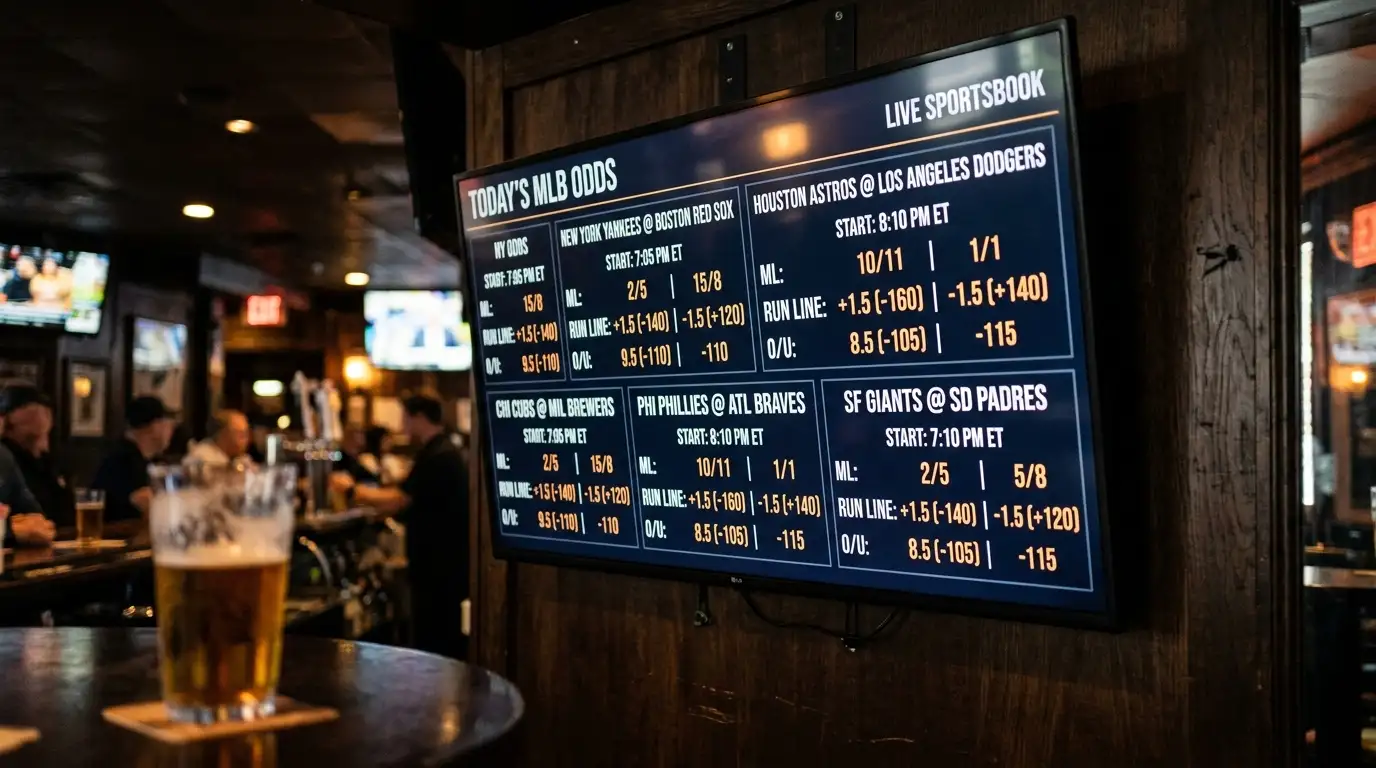
Underdogs winning at that rate changes everything. In football, bottom-table sides upset top-six clubs perhaps 15-20% of the time. In baseball, even the worst team beats the best roughly four times out of ten across a full series. The 162-game season produces enormous sample sizes that smooth out variance, and it means the moneyline on moderate underdogs is often the smartest entry point for a new baseball bettor.
If you want a proper step-by-step walkthrough — from creating your account to reading your first betting slip — I have written a dedicated beginner’s guide to betting on baseball that goes much deeper into the mechanics.
Understanding the bets is the first step — but where you place them matters just as much.
Choosing a UK Sportsbook for Baseball
Last April, I ran an experiment. I took the same five MLB moneyline bets across seven UK-licensed sportsbooks on the same evening and tracked the odds at the exact same timestamp. The difference between the best and worst price on a single game was 0.12 in decimal terms — on a 50 pound stake, that gap translated to 6 pounds of dead money left on the table for no reason other than not checking a second screen. Multiply that across a season of 200+ bets and you begin to understand why sportsbook selection is not a formality.
The UK currently has 5,825 licensed betting shops, though that number falls every year as the market shifts online. For baseball, the shift is even more pronounced — you will not find MLB odds on the board at your local bookmaker. This is a digital-first market, and the sportsbook you choose needs to deliver on a specific set of baseball criteria that differ from what makes a good football book.
MLB market depth
Does the book offer moneyline, run line, totals, first 5 innings, player props and futures — or just the basics?
Odds margin
The average hold in US sports betting runs around 10.15%. UK books on baseball can be tighter or wider — compare before committing.
Live betting coverage
Not every UK sportsbook provides in-play markets for all 15 daily MLB games. Check whether your book covers the full slate or just marquee matchups.
Cash out and early settlement
Baseball games swing late. A sportsbook offering partial cash out on baseball — not just football — gives you more control over live positions.
UKGC licensing is non-negotiable. Andrew Rhodes, CEO of the UK Gambling Commission, has been clear about the direction of travel: strengthening regulation, improving consumer protections and making gambling safer and fairer. Every sportsbook I evaluate must hold a valid remote betting licence from the Gambling Commission. If a site does not display its licence number in the footer, close the tab. Full stop.
Beyond licensing, I look at three practical factors that most affiliate reviews gloss over. First, how quickly does the book update its MLB lines after a starting pitcher change? Late scratches happen regularly in baseball, and a sportsbook that is slow to adjust its prices after a lineup card change is either understaffed on their baseball desk or offering you stale odds by design. Second, does the book price in fractional odds by default, or do you have to manually toggle from American lines? It sounds minor, but a clean interface that speaks your format reduces decision friction on fast-moving in-play markets. Third — and this one surprises people — does the sportsbook offer team totals, not just game totals? Team totals let you isolate one side of the scoring, which opens up angles that the standard over/under cannot reach.
I have put together a full ranked breakdown of the best baseball betting sites in the UK with margin analysis, market depth scores and mobile experience ratings. That piece goes into the granular comparisons — here, the point is simpler: treat your sportsbook choice as your first strategic decision, not an afterthought.
One more consideration specific to 2026. The Remote Gaming Duty hike from 21% to 40% — effective April — is putting pressure on operator margins. Some books will absorb the cost; others will widen their odds to compensate. Keeping accounts at multiple UKGC-licensed sportsbooks is no longer optional for anyone serious about baseball betting. In a post-tax-hike market, the value gap between books is only getting wider.
Reading Baseball Odds in Fractional, Decimal and American Formats
A friend once texted me a screenshot from a US betting site showing the Yankees at -145 and asked, “Is that good?” He had no frame of reference because he had only ever seen fractional odds on UK sportsbooks. The truth is, all three formats — fractional, decimal and American — describe the same price. The difference is presentation, and once you can convert between them, you will never be confused by a line again.
UK sportsbooks default to fractional odds. When you see a baseball team priced at 5/4, you are being told that for every 4 pounds you stake, you win 5 pounds in profit plus your stake back. The number on the left is your profit; the number on the right is your stake. Fractions larger than 1/1 (evens) indicate an underdog; fractions smaller than 1/1 indicate a favourite. Simple enough — but fractional odds can obscure implied probability more than the other formats, which is why I always recommend switching your display to decimal when you are analysing value.
Converting fractional to decimal to implied probability
Fractional odds: 5/4
Decimal conversion: (5 / 4) + 1 = 2.25
Implied probability: 1 / 2.25 = 0.4444, or 44.4%
This means the sportsbook considers the team to have roughly a 44% chance of winning — before the margin is applied.
American odds use a baseline of 100. A minus figure (e.g. -150) tells you how much you must stake to win 100. A plus figure (e.g. +130) tells you how much you win on a 100 stake. UK bettors rarely need American odds, but if you follow US-based MLB analysts or podcasts, you will encounter them constantly.
The practical lesson here is about the margin — the bookmaker’s built-in edge. If you convert both sides of a moneyline to implied probabilities and they add up to more than 100%, the difference is the overround. A combined total of 105% means the sportsbook is taking roughly a 5% cut. On baseball, margins at UK books typically sit between 4% and 8% on the moneyline market, though less liquid props and futures can run higher. The average hold across US sports betting sits at 10.15%, which gives UK punters a useful benchmark — if your book is consistently wider than that, you are overpaying.
My working habit: I keep my primary sportsbook in fractional odds because that is my native format, but I use a secondary account set to decimal when I am comparing lines. Decimal strips out the mental arithmetic and lets me see relative value at a glance. When you are scanning 15 games on a busy MLB evening, that speed matters.
The MLB Betting Landscape in 2026
If you had told me five years ago that Major League Baseball would sign a partnership deal worth roughly $300 million with a prediction market platform, I would have assumed you were confusing baseball with crypto. Yet here we are: the MLB-Polymarket deal announced in March 2026 is real, it is enormous and it signals a fundamental shift in how professional sports leagues view wagering — not as a vice to tolerate, but as a revenue stream to embrace.
Tax alert for UK punters: Remote Gaming Duty rose from 21% to 40% on 1 April 2026, with a further shift to a 25% remote betting rate from April 2027. The government projects these changes will generate 810 million pounds in 2026/27, scaling to 1.16 billion pounds by 2030/31. For bettors, the immediate consequence is that operators under margin pressure may pass costs through via wider odds — making line comparison more important than ever.
MLB Commissioner Rob Manfred has framed the league’s position bluntly. He sees centralised federal oversight as far simpler than navigating a patchwork of state regulations, and he believes the sport is in a better position today to monitor what is happening in the betting markets than it was when wagering was entirely underground. That is a remarkable statement from the head of a league that banned Pete Rose for life. The institutional stance has flipped 180 degrees in a generation.
On the revenue side, MLB’s record $12.1 billion in 2024 earnings reflect a league that has figured out how to monetise everything from streaming rights to in-stadium experience. For UK bettors, the downstream effect is more data, more broadcast access and more competitive sportsbook pricing as operators fight for baseball handle. The global baseball market — covering everything from merchandise to media rights — sits at $11.35 billion and is projected to climb past $15 billion by 2030, which tells you the infrastructure around the sport is expanding, not contracting.
US sports betting handle exceeded $165 billion in 2025, with cumulative wagers since the 2018 PASPA repeal surpassing $600 billion. Baseball’s share of that handle has grown consistently as sportsbooks expand their MLB prop and live markets.

The prediction-market angle deserves attention even if you never plan to use Polymarket yourself. Senator Richard Blumenthal has criticised the partnership as giving “gambling’s ugly takeover of sports” the league’s official blessing, while the American Gaming Association’s Bill Miller has argued that a federal deal does not override state-level sports betting frameworks. This tension matters for UK bettors because prediction-market pricing data — essentially a parallel set of odds generated by crowd consensus rather than bookmaker models — is increasingly available to cross-reference against traditional sportsbook lines.
The 2026 season, in short, sits at an inflection point. Regulation is tightening in the UK while the commercial relationship between baseball and betting deepens in the US. UK punters who understand both sides of that equation — the tax pressure at home and the data expansion abroad — are the ones positioned to find genuine value across the season.
Core Bet Types for Baseball at a Glance
Run Line vs Moneyline Calculator
The run line pays more than the moneyline – but the favourite has to win by two, and more than a quarter of MLB games finish within a single run. Enter both prices and your read, and see which market actually holds the value.
How this works: both prices convert to an implied probability (1 ÷ decimal, or the fractional/American equivalent), and value = (your probability × decimal odds) − 1 per £1 – positive means the price pays more than your read says it should. The trade-off is the whole point. The moneyline only asks the favourite to win, so its win probability is high but the price is short. The run line −1.5 pays a longer price, but the favourite now has to win by two or more runs – and because roughly 28% of MLB games are decided by exactly one run, that extra margin is far from a formality. Even the best 2024 teams covered the run line under 56% of the time. Your two probability inputs are different questions: the moneyline needs your read on winning, the run line needs your read on winning by 2+, which is always the lower number. The calculator compares the value of each and highlights the market where your edge is bigger. A short-priced favourite you’re confident in often has more value on the run line; a coin-flip game usually keeps its value on the moneyline. This is a pricing tool, not a tip – the outputs are only as good as your two probability reads. Not financial advice. 18+ – GamStop and BeGambleAware are protection routes; National Gambling Helpline 0808 8020 133.
When I first mapped out every bet type available on a single MLB game at a UK sportsbook, I counted 47 distinct markets. That was three years ago. Today, some books push past 120 markets per game when you include player props and inning-by-inning lines. The good news: you only need to master four or five to be a competent baseball bettor. The rest are variations on those same foundations.
Moneyline
Pick the winner. No spread, no margin of victory — just which team takes the game. This is the most popular baseball bet globally, and the one where the underdog’s 43-44% win rate creates the most persistent value opportunities. If you bet nothing else, bet moneylines.
Run line
Baseball’s handicap, almost always fixed at +/-1.5 runs. Backing the favourite at -1.5 pays better than the moneyline but requires a two-run win. Backing the underdog at +1.5 gives you a cushion — they can lose by one and you still collect. The best teams in 2024 covered the run line less than 56% of the time, which tells you even dominant sides struggle to win by two consistently.
Totals (over/under)
Bet on whether the combined runs scored by both teams exceed or fall short of the sportsbook’s set line. Lines typically range from 7.0 to 9.5 depending on the pitching matchup, ballpark and weather. This market is where sabermetrics — advanced stats like ERA, WHIP and FIP — have the most direct application.
Props and futures
Player props isolate individual performance: a pitcher’s strikeout total, a batter’s hit count, a base-stealer’s stolen-base line. Futures project further ahead — World Series winner, division champion, MVP. Props reward specialist knowledge; futures reward patience and timing.
First 5 innings (F5) — a bet that settles based only on the score after the first five innings, removing bullpen performance from the equation. F5 moneyline and F5 totals isolate the starting pitcher’s contribution, making them a favourite among analytical bettors who build models around pitching matchups rather than full-game outcomes.
The market I want to flag specifically is F5 — first 5 innings — because most UK-facing guides either ignore it or mention it in passing. In a sport where bullpen volatility can erase a three-run lead in the seventh inning, being able to bet only on the portion of the game controlled by the starting pitchers is a significant analytical advantage. If your model says one starter dominates the other but both bullpens are shaky, the F5 line lets you isolate the edge and avoid the noise.
Parlays — accumulators in UK parlance — are available across all these markets, including same-game parlays that combine a moneyline, a player prop and a total from a single fixture. The mathematics work against you on parlays (the overround compounds with each leg), but correlated parlays where the legs logically connect — for instance, backing the over on team totals alongside a batter’s hits line — can offer structural value that single-market bets cannot. The key is understanding which combinations are correlated and which are independent. That distinction is the difference between gambling and strategy.
For a full walkthrough of every market with worked odds examples, I have built a dedicated guide to baseball bet types explained that goes well beyond this overview.
Strategy Fundamentals for Smarter Baseball Bets
Early in my career modelling MLB odds, I made the mistake every analytical bettor eventually makes: I overthought the system and ignored the basics. I was building elaborate multi-variable models while neglecting to check whether the starting pitcher had been scratched 30 minutes before first pitch. Strategy in baseball does not start with algorithms — it starts with discipline, information flow and an honest understanding of where your edge actually comes from.
Do
- Check the confirmed starting pitcher for both teams before placing any bet — a late scratch can shift the moneyline by 30 or more points
- Compare odds across at least three UKGC-licensed sportsbooks on every bet (line shopping is the simplest edge that requires zero analytical skill)
- Focus your volume on the regular season, where 162 games per team create the sample sizes needed for statistical models to work
- Track every bet in a spreadsheet — stake, odds, market, result and your reasoning — so you can audit your own process
Don’t
- Chase losses by increasing stakes after a bad run — baseball’s natural variance means even profitable strategies produce losing streaks of 10+ bets
- Bet every game on the slate — selectivity is an edge, and the best bettors I know wager on fewer than 20% of available games
- Ignore bullpen fatigue, especially during series where teams play three or four consecutive days
- Rely on generic “expert picks” that do not show a verified long-term track record
The starting pitcher is the single biggest variable in any baseball bet. Rob Manfred himself has acknowledged that baseball is in a better position now to understand market activity than it was when everything was underground — and part of that transparency comes from the sheer volume of pitcher data available to anyone willing to look. ERA, FIP, WHIP, left-right splits, home-away splits, performance in day games versus night games — these are not locked behind paywalls. They are published by MLB and freely accessible. The bettor who cross-references a starter’s recent form with the opposing lineup’s platoon splits has a material information advantage over someone betting on team reputation alone.
Average MLB game duration dropped to 2 hours 36 minutes in 2024 — the shortest in 40 years — which has changed the strategic calculus for in-play and F5 markets. Faster games compress the window in which odds move, which means your pre-game research matters more, not less. You have fewer opportunities to correct a bad live-betting entry when the game is over in under three hours.
Pre-bet checklist for MLB
- Confirmed starting pitchers for both teams (check within 60 minutes of first pitch)
- Bullpen availability: how many innings did each team’s relievers throw in the past 48 hours?
- Weather at the ballpark: wind speed, direction and temperature (especially for totals bets)
- Line comparison across at least three UK sportsbooks — take the best available price
- Bankroll check: does this bet fit within your per-game staking limit?
That underdog win rate of 43-44% is the statistical backbone of every contrarian baseball strategy. When the public loads onto a big-name favourite, the odds on the other side lengthen beyond what the true probability justifies. Fading the public is not a universal rule — sometimes the favourite deserves the short price — but across the regular season’s massive sample, a selective approach to underdog moneylines has documented positive expected value.
I have written a full baseball betting strategy guide that breaks down pitcher matchup analysis, closing line value and seasonal bankroll frameworks in much more detail. What matters here is the principle: strategy in baseball is not about predicting the future — it is about identifying the spots where the sportsbook’s price does not reflect the data.
Live Betting and In-Play Markets for Baseball
The first time I placed a live bet on baseball, I was watching a Dodgers game at midnight and the moneyline on the trailing team jumped to 9/2 after they went down by two runs in the third inning. I took it. They came back in the sixth, tied it in the seventh and won in the ninth. That payout — from a position most casual bettors had already written off — taught me more about in-play value than any textbook ever could.
In-play baseball betting covers any market offered after the first pitch. UK sportsbooks typically provide live moneylines, live run lines, next-inning totals, next-team-to-score markets and sometimes live player props. The availability varies by book and by game — marquee matchups receive full in-play treatment, while early-afternoon weekday games may have thinner coverage.
Baseball’s structure makes it unusually well-suited to live betting. The game operates in discrete units — half-innings — with natural pauses between them. Each pitching change is an inflection point that resets the odds. Compare this to football, where play is continuous and live odds adjust in a smooth stream. In baseball, the odds jump in steps. A starter getting pulled in the fifth inning with a one-run lead can swing the moneyline by 15 to 20 points in seconds, depending on who enters from the bullpen. If you know the bullpen matchups before the sportsbook adjusts, you have a window — a brief one, but a real one.
UK punters place roughly 290 million online bets on real events each month, and 95% of those bets are made from home. For baseball, the home-betting dynamic is amplified by time zones: most MLB games kick off between 11pm and 1am UK time, which means you are watching on a second screen or a mobile app, not in a pub surrounded by distractions. That focused environment suits live betting well. You can track pitch counts, watch the in-game stream (several UK sportsbooks offer MLB live streaming to funded accounts) and react to momentum shifts in near-real time.
The risk in live baseball betting is latency. Your feed — whether streamed through the sportsbook or a third-party broadcast — runs 5 to 30 seconds behind actual play. A run can score before your screen shows it, and the odds engine will have already priced it in. I treat in-play bets as pre-researched positions executed when the price reaches a predetermined threshold, rather than reactive punts made in the heat of the moment. That distinction — planned versus impulsive — separates profitable live bettors from those who donate money to the margin.
Cash out is the other in-play tool worth understanding. Partial cash out on baseball is available at several UK books and lets you lock in a portion of your profit (or cut a portion of your loss) before the game ends. The sportsbook prices cash-out offers with their own margin built in, so the question is always whether the offer on the table exceeds what your own model says the position is worth. If you are ahead and the opposing team’s closer is warming up with a poor recent form line, cashing out part of the position can be the smartest play.
For deeper tactical breakdowns — including inning-by-inning odds patterns and how to time your entries around pitching changes — see my guide to live baseball betting.
Responsible Gambling and Bankroll Discipline
I have seen sharp bettors — people with genuine analytical edges and profitable track records — blow up their bankrolls because they treated a Tuesday night Padres game like it was the World Series. Talent does not protect you from poor staking. The 162-game MLB season is a marathon, and marathons punish sprinters.
The UK participation picture: around 8% of UK adults placed a sports bet online or through an app in the four weeks between July and October 2025, with participation skewing heavily by gender — 15% of men versus 4% of women. These figures from the Gambling Commission’s latest survey are a reminder that sports betting is widespread enough to normalise risk-taking behaviour, which makes self-imposed structure essential.
Bankroll management in baseball is different from football because the volume is so much higher. The Premier League gives you 380 matches across an entire season. MLB gives you that many in about three weeks. The temptation to bet every game — or worse, to increase stakes to “make up” a losing run — is constant and corrosive. My personal rule is a flat 1-2% of total bankroll per bet, with no exceptions. On a 1,000 pound bankroll, that means 10 to 20 pound stakes. It feels small. It is designed to feel small. Because the edge in baseball betting compounds over hundreds of bets, not dozens, and you need to survive long enough for the mathematics to work.
Do
- Set a daily loss limit before the first game starts and close your app when you hit it
- Use the deposit limit tools that every UKGC-licensed sportsbook is required to offer
- Take at least one full week off from betting every month — it resets your judgment
Don’t
- Chase losses with larger stakes on late-night games you have not researched
- Treat betting as entertainment that “pays for itself” — separate your entertainment budget from your bankroll
- Ignore signs of escalation: betting more than planned, feeling anxious about results, hiding bet amounts
Helen Rhodes, Director of Major Policy Projects at the Gambling Commission, has pushed back against what she calls ill-informed commentary around financial risk assessments — the tools operators use to flag customers who may be spending beyond their means. Those assessments exist to protect you, not to restrict you. If a sportsbook asks you to verify your source of funds, treat it as a safety mechanism, not an obstacle.
If betting stops being something you choose to do and starts feeling like something you need to do, the tools are there. GamStop provides a single self-exclusion registration that covers all UKGC-licensed online gambling sites. GamCare offers free counselling and a helpline. The NHS runs its own National Gambling Treatment Service. These are not last-resort measures for crisis situations — they are first-line resources designed to catch problems early. A profitable betting strategy means nothing if the process makes you miserable.
UK Regulation: UKGC Licensing and the 2026 Tax Changes
In February 2026, the Gambling Commission reported sending 741 cease-and-desist orders to unlicensed operators and flagging nearly 398,000 illegal URLs to search engines. That is not background noise — it is an active enforcement campaign, and it directly affects which sportsbooks you should and should not trust with your money when betting on baseball.
The duty hike in numbers: Remote Gaming Duty climbed from 21% to 40% on 1 April 2026, with a separate remote betting duty of 25% arriving in April 2027. The government’s own projections estimate these reforms will generate 810 million pounds in the 2026/27 fiscal year, scaling to 1.16 billion pounds annually by 2030/31. The stated aim is a “fair, modern and sustainable tax system” — but for operators, it represents a near-doubling of their tax burden on remote gaming revenue.
Every legal sportsbook operating in the UK holds a licence from the Gambling Commission, and that licence comes with enforceable conditions: segregated customer funds, mandatory self-exclusion tools, affordability checks and complaint resolution through an approved alternative dispute resolution provider. If you are betting on baseball at a UKGC-licensed book, you have these protections by default. If you are betting offshore, you have none of them.
The black market is not a theoretical risk. UK black market betting volume reached 16.6 billion pounds in 2025 — roughly triple the level recorded in 2019. Tim Miller, Executive Director of the Gambling Commission, has spoken about the publication of a national risk assessment on the illegal market, and HM Treasury allocated an additional 26 million pounds over three years specifically for the UKGC to combat unlicensed gambling. The expansion of the illegal market is partly driven by operators who left the UK regulated space as compliance costs rose — some of those operators now target the same UK customers from jurisdictions with weaker oversight.

For baseball bettors specifically, the regulatory picture has a practical dimension. The 40% RGD rate increases the cost of doing business for every licensed sportsbook, and that cost has to go somewhere. Some operators will absorb it from profit margins — Flutter Entertainment, the group behind Sky Bet and Paddy Power, posted 15.91 billion dollars in group revenue for 2025, a 17% increase, which suggests the largest operators have room to absorb. Smaller books may not. The outcome for you as a punter is a widening spread in odds quality between operators: the sportsbooks with the deepest pockets will offer sharper baseball lines, while undercapitalised books will price more conservatively to protect their margins.
This is why I keep returning to the same advice: maintain accounts at multiple UKGC-licensed sportsbooks and compare prices before every bet. The sportsbooks that survive the tax hike and the compliance squeeze will be the ones worth betting with — and you identify them by watching their odds, not their marketing.
Tim Miller has also signalled that the UKGC is exploring a potential path for crypto assets as a consumer payment option within licensed gambling — still early-stage, but indicative of a regulator thinking forward. For now, the message is straightforward: stick to licensed operators, verify the licence number and understand that the tax changes reshaping the market are designed to keep the ecosystem cleaner, even if they make your odds a fraction wider in the short term.
Frequently Asked Questions
What types of bets can you place on baseball in the UK?
UK sportsbooks offer a wide range of baseball markets. The core three are the moneyline (picking the outright winner), the run line (a 1.5-run handicap similar to the spread in American football) and totals (over/under on the combined runs scored). Beyond those, you will find first 5 innings bets that isolate starting-pitcher performance, player props covering individual statistics like strikeouts or hits, futures markets for the World Series and division winners and parlays (accumulators) that combine multiple selections into a single bet. The exact depth of markets varies by sportsbook — some UK books offer 120+ markets per MLB game, while others stick to the basics. Checking market depth before committing to a sportsbook is one of the simplest ways to ensure you have the flexibility to bet the way your analysis demands.
Is baseball betting legal in the UK?
Yes. Betting on baseball is fully legal in the UK provided you use a sportsbook licensed by the UK Gambling Commission. The UKGC regulates all remote betting operators serving UK customers, and its licence conditions include mandatory consumer protections such as deposit limits, self-exclusion options and segregated customer funds. There is no restriction on which sport you bet on — MLB, NPB, KBO and other baseball leagues are all available at licensed UK books. What is not legal is betting with unlicensed offshore operators, which fall outside the UKGC’s enforcement framework and offer no recourse if something goes wrong.
What is the best betting site for MLB in the UK?
There is no single “best” site because the answer depends on what you prioritise. If your focus is odds quality, you need to compare margins across multiple books on the same game — the tightest-priced sportsbook for baseball may not be the same one that leads on football. If you value live betting depth, look for a book that offers in-play markets on every MLB game, not just marquee fixtures. If mobile experience matters most, test the app before depositing. What I recommend universally is maintaining accounts at a minimum of three UKGC-licensed sportsbooks so you can always take the best available line. The 2026 tax changes mean operator pricing will diverge more than in previous years, which makes multi-account line shopping the single most impactful habit you can build.
How do baseball odds work in fractional format?
Fractional odds — the UK default — express your potential profit relative to your stake. Odds of 5/4 mean you win 5 pounds profit for every 4 pounds staked, plus your original stake back, giving you a total return of 9 pounds on a 4-pound bet. To convert fractional odds to implied probability, divide the right-hand number by the sum of both numbers: for 5/4, that is 4 / (5+4) = 44.4%. Favourites appear as fractions below evens (e.g. 4/6, where you risk more than you stand to win) and underdogs appear above evens (e.g. 6/4). You can switch most UK sportsbooks to display decimal or American odds if you prefer, but fractional remains the default presentation and the one most UK punters are comfortable reading.
What is a run line bet in baseball?
The run line is baseball’s equivalent of the point spread in American football or the handicap market in UK football betting. It is almost always set at 1.5 runs. When you back the favourite at -1.5, they need to win the game by two or more runs for your bet to pay out. When you back the underdog at +1.5, they can lose the game by a single run and your bet still wins. About 28% of MLB games are decided by exactly one run, which means the run line adds a meaningful layer of risk and reward compared to the moneyline. Alternate run lines — where the spread is adjusted to 2.5 or higher — are available at many UK sportsbooks and offer different odds to reflect the wider or narrower margin.
Can you live stream MLB games at UK betting sites?
Several UK sportsbooks offer live streaming of MLB games to customers who hold a funded account or have placed a qualifying bet. The availability varies by operator and by broadcast rights agreements, so not every game on the schedule will be streamed at every book. In practice, the larger UKGC-licensed sportsbooks tend to cover a solid portion of the MLB slate, especially evening games in the US (which fall in the late-night window for UK viewers). Live streaming through your sportsbook has a practical advantage for in-play betting: the stream and the odds are on the same platform, which reduces the friction of switching between apps when you spot a live-market opportunity.
What is the moneyline in baseball betting?
The moneyline is the simplest and most popular bet in baseball. You are picking which team wins the game — no spread, no margin of victory, no total. If your team wins by one run or by ten, the moneyline pays the same. In fractional odds, a favourite might be priced at 4/6 (you risk 6 to win 4 in profit) while the underdog sits at 6/4 (you risk 4 to win 6 in profit). Because baseball has no draws — extra innings settle every game — the moneyline is a pure binary outcome. The underdog moneyline is particularly compelling because underdogs win roughly 43-44% of all MLB games, the highest upset rate in any major professional sport.
Created by the ”Betting for Baseball” editorial team.