
Baseball Parlay Betting Guide: Combining MLB Selections for Bigger Returns
 Available in US
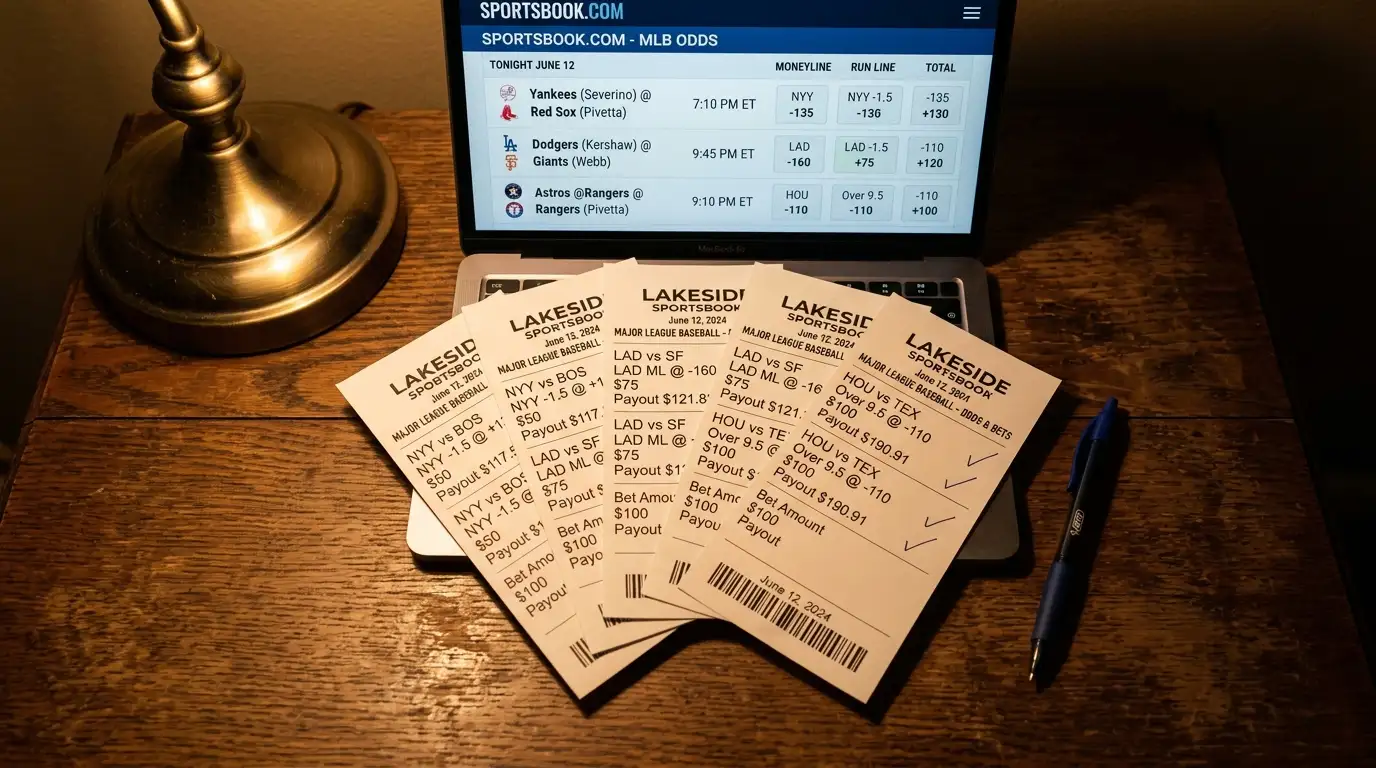
The Allure and the Algebra of Multi-Leg Bets
My biggest single-day return in baseball betting came from a four-leg parlay that paid just under 12/1. Three heavy favourites and one totals selection, all landing on the same Tuesday night in August. The payout was exhilarating. What I do not mention as often is the 23 consecutive parlays before that one which all lost. The maths of parlays is brutally simple: the payouts look enormous because the probability of winning is genuinely low.
A parlay — called an accumulator in UK betting terminology — combines two or more selections into a single bet. All legs must win for the bet to pay out. The odds multiply, which is why a four-leg parlay at even-money selections pays roughly 15/1 rather than 4/1. That multiplicative effect is both the attraction and the trap. Each additional leg increases the potential payout but decreases the probability of success at a compounding rate.
Underdogs win roughly 43-44% of MLB games outright. That means even a heavy favourite with a 60% win probability has a 40% chance of losing on any given night. String three such favourites into a parlay and the combined probability drops to about 21.6% — less than one in five. The sportsbook knows this, which is why parlays are among the most profitable products for operators. UK remote betting GGY hit $7.8 billion in the year to March 2025, and parlay revenue contributes a disproportionate share of that figure relative to the number of parlay bets placed.
See also: build October parlays with our World Series betting guide.
When Parlays Make Mathematical Sense in Baseball
Blanket advice against parlays is lazy. There are specific conditions under which combining baseball selections into a multi-leg bet is not just acceptable but strategically sound. The key is understanding when the multiplicative odds offered by the sportsbook exceed the true combined probability of your selections.
The first condition is correlated legs — selections that are more likely to occur together than independently. If you back a dominant starting pitcher to win and the Under in the same game, those outcomes are positively correlated: a dominant pitching performance makes both a team win and a low-scoring game more likely. Most sportsbooks price parlay legs as independent events, which means the combined odds of correlated legs are slightly more generous than the true probability warrants. That mispricing is small on any single bet but meaningful across hundreds of parlays over a season.
The second condition is exploiting short-priced favourites. A moneyline favourite at 1/4 (implied 80%) offers tiny singles profit. Three such selections at 1/4 each produce a parlay at roughly 1.95/1 — nearly 2/1 — with a combined implied probability of 51.2%. If you genuinely believe each selection is more likely than 80%, the parlay offers a better vehicle for expressing that confidence than three separate singles at 1/4 each.
The third condition is bankroll efficiency. If your total staking budget is limited, a small parlay stake captures upside that flat-betting the same selections individually cannot. A $5 parlay at 10/1 returns $55. Spreading that same $5 across five $1 singles at short prices might return $6.50 total. The variance is higher, but the capital efficiency is dramatically better for bettors with small bankrolls.
Structuring a Baseball Parlay: Two Legs, Not Ten
A friend of mine once showed me his weekend parlay slip — nine MLB legs, expected payout over 500/1. I asked him how many nine-leg parlays he had hit in his career. The answer was zero. The payout was fantasy; the bet was a donation. That conversation crystallised my approach: baseball parlays work at two to three legs. Anything beyond four is entertainment, not strategy.
Two-leg parlays are the sweet spot. The probability reduction from the second leg is the smallest relative marginal cost you will pay. A single bet at 4/5 has an implied probability of roughly 55.6%. Adding a second leg at 4/5 drops the combined probability to about 30.9%, but the payout jumps from 4/5 to approximately 2.25/1. You are giving up 25 percentage points of probability in exchange for a near-tripling of the potential return. That trade-off is worthwhile when both legs have genuine analytical support.
Three-leg parlays are acceptable if each leg carries at least a 55% estimated probability. At those inputs, the combined probability sits around 16.6%, and the payout typically exceeds 5/1. The expected value can be positive if your individual selection accuracy consistently beats 55%, which is achievable with disciplined analysis. Beyond three legs, the cumulative probability drops below 10%, and even skilled handicappers cannot maintain the per-leg accuracy required to make four-plus-leg parlays profitable over time.
My favourite two-leg structure combines a moneyline favourite with a totals selection from a different game. This eliminates correlation between legs (they are from separate games) while keeping each individual probability above 55%. The lack of correlation means the sportsbook’s parlay pricing is fair rather than disadvantageous, and you are simply leveraging two independent edges into a single higher-paying position.
Same-Game Parlays: Baseball’s Double-Edged Sword
Same-game parlays — combining multiple selections from a single MLB game — have exploded in popularity since UK sportsbooks began offering them. The appeal is obvious: you can back a team to win, the Under and a specific pitcher to record over 5.5 strikeouts, all in one bet at dramatically enhanced odds. The pricing, however, is where the trap lies.
Unlike traditional parlays where the operator multiplies independent odds, same-game parlays are priced using proprietary models that account for correlation — and often overcharge for it. The sportsbook knows that a team win and the Under are correlated, so the combined odds are shorter than a naive multiplication would suggest. That adjustment is appropriate in principle, but in practice, the operator’s correlation model tends to be more conservative than the actual relationship, extracting a larger margin.
I use same-game parlays sparingly, and only when the correlation between legs is stronger than I believe the sportsbook’s model assumes. Backing a team’s ace to win, the Under and the pitcher to record 7+ strikeouts is a high-correlation package because elite starters simultaneously suppress runs, win games and accumulate strikeouts. If the sportsbook is pricing those legs as though the strikeout prop is weakly correlated with the game outcome, the combined price undervalues the true probability.
The average hold percentage in US sports betting — 10.15% in 2025 — gives you a baseline for how much margin operators build into standard markets. Same-game parlays carry a significantly higher hold, sometimes exceeding 20%. That margin erodes your expected value faster than traditional parlays, which is why same-game parlays should form a small, targeted portion of your overall approach rather than a daily habit.
See also: betting for baseball for parlay tips and single-bet strategies.
Parlays as Part of a Broader Staking Plan
I allocate exactly 10% of my weekly MLB staking budget to parlays. The other 90% goes to singles — moneylines, run lines and totals where I have identified individual edges. That 10% allocation caps my parlay exposure at a level where a losing week does not damage my overall bankroll, while a winning parlay provides a meaningful boost that singles alone would take weeks to replicate.
The 10% rule also imposes natural discipline on leg count. If my weekly parlay budget is $50, a single two-leg parlay at $25 makes sense. Four separate four-leg parlays at $12.50 each does not, because the combined probability of winning any of them is lower than the single two-legger despite the identical total outlay. Fewer bets at higher individual stakes is the correct structure for parlay profitability.
Record every parlay in your tracking spreadsheet — not just the outcome but the individual legs, their estimated probabilities and the actual result of each leg. Over a season, this data reveals whether your losing parlays are failing on specific leg types (totals, underdogs, props) or across the board. If one category consistently kills your parlays, remove it. If your two-leggers show positive ROI but your three-leggers do not, stick to doubles. The data tells you exactly where your parlay strategy works and where it bleeds.
Parlays are a tool, not a strategy. They amplify edges that already exist in your analysis and help you avoid the traps that sink most recreational bettors. Used with discipline, they add a high-upside layer to a portfolio built on singles. Used without discipline, they are the fastest way to empty a bankroll in baseball betting.
How many legs should a baseball parlay have?
Two to three legs is the optimal range. At two legs, the probability reduction is manageable and the payout roughly triples. Beyond three legs, the combined probability drops below 10%, making consistent profitability extremely difficult even for skilled bettors.
Are same-game parlays a good bet in MLB?
Same-game parlays carry a higher house margin than traditional parlays because operators charge extra for correlated outcomes. They can offer value in specific situations — such as backing an ace to win, go Under and record high strikeouts — but should be used sparingly and only when you believe the correlation is stronger than the sportsbook’s pricing assumes.
Prepared by the Betting for Baseball editorial staff.